 RATPOOL
Play-to-Earn vs Skill-to-Earn: Which Is Better?
Axie Infinity and STEPN paid players in tokens they minted, and both collapsed. Follow the money to see why skill-to-earn doesn't need hype to keep paying.
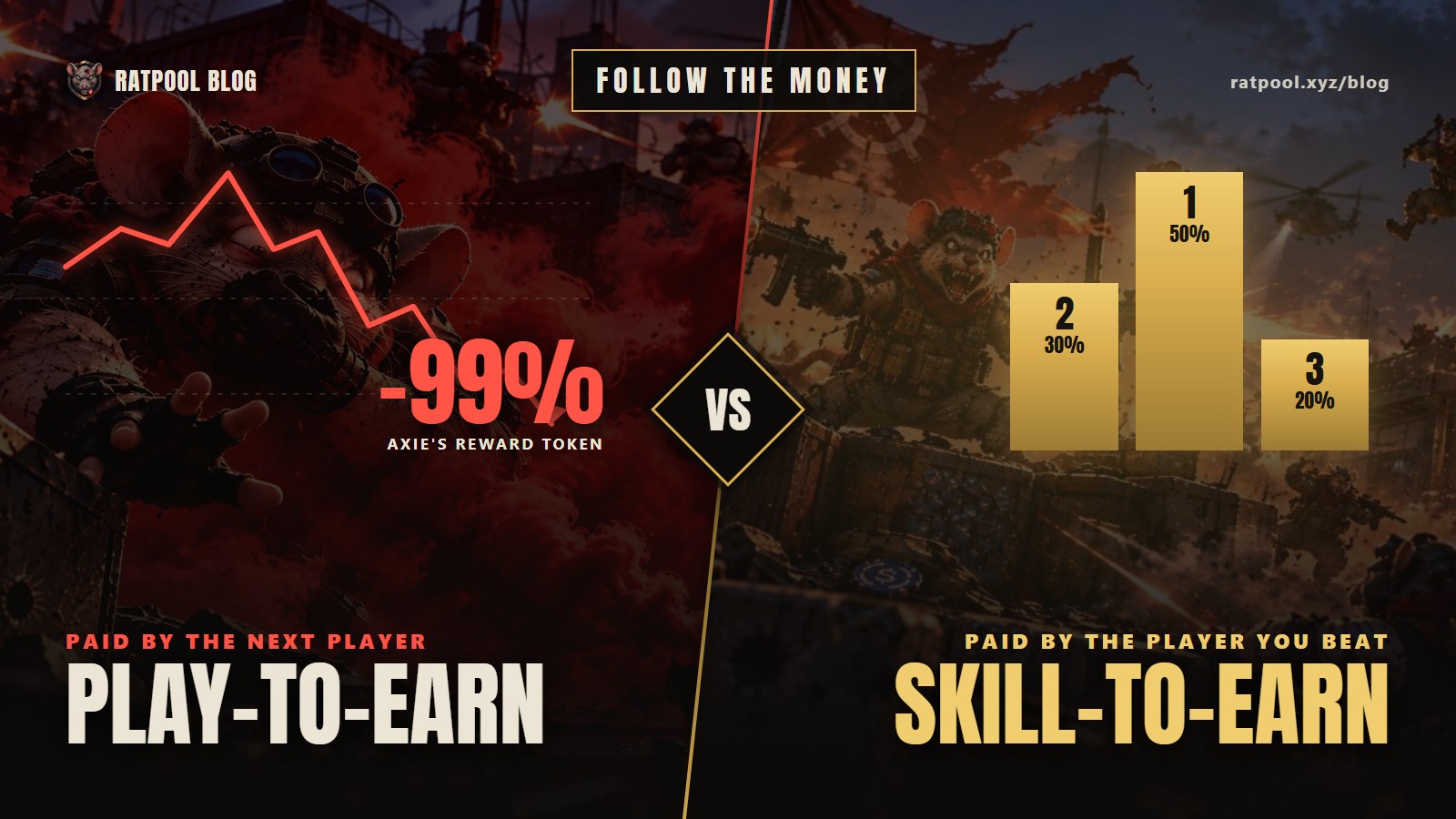
Skill-to-earn is the better model for most players. In play-to-earn, your rewards are printed by the game and paid for by whoever joins after you. In skill-to-earn, every dollar you win was put on the table by someone you actually beat. Play-to-earn games like Axie Infinity and STEPN grew very fast because they paid people in tokens just for playing, and they shrank just as fast once new players stopped buying in. Skill-to-earn games pay out of entry stakes the players put up themselves, so the money in the game is real money that already exists, and the people who get paid are the ones who played best.
That's the short answer. The rest of this article is the long one, because the difference between these two models looks small until you follow the money. Once you follow it, you'll see why one model kept collapsing and why the other one doesn't depend on hype to keep paying.
Why this question matters again in 2026
If you were in crypto around 2021, you remember when play-to-earn was the biggest story in the space. People who had never touched a blockchain were downloading games, buying NFT characters and earning tokens every day. The idea was simple and very attractive. You play a game you'd play anyway, and the game pays you for your time.
Then most of it fell apart, and for a long time the word "GameFi" made people roll their eyes. A lot of people concluded that earning from games was a scam idea from the start.
That conclusion is understandable, and it's also wrong. Wanting to earn from games was never the problem, because people already earn from games all the time. Professional esports players earn, chess players win prize money, and people have played pool and darts for stakes in bars for decades. The problem was the specific way play-to-earn tried to pay people. Now that a new wave of crypto games is coming in under the "skill-to-earn" label, it's worth understanding exactly what went wrong the first time, so you can tell which new games learned the lesson and which ones are just the old model with new paint.
How play-to-earn actually works
Strip away the graphics and most play-to-earn games run on the same engine.
First, you usually have to buy something to get in. In Axie Infinity it was a team of three NFT creatures called Axies. In STEPN it was an NFT sneaker. That entry cost is the first important detail, because it means every new player brings fresh money into the game the moment they join.
Second, the game rewards you with a token for playing. Axie paid in Smooth Love Potion (SLP), and STEPN paid in Green Satoshi Token (GST). These tokens were created by the game as rewards. Nobody deposited them, and they weren't taken from another player. The game minted them out of nothing whenever someone completed a task, won a battle or went for a walk.
Third, and this is the part people skipped, those reward tokens only have value if someone buys them. When you earn SLP and sell it for dollars, somebody on the other side of that trade is paying you dollars for it. So who was buying? Mostly the game's own economy. SLP was used to breed new Axies, and new Axies were sold to new players who needed a team to start. GST was used to level up and mint sneakers, and new sneakers were sold to new users who wanted to start walking and earning.
Put those three pieces together and you can see the loop. New players buy in, their money flows to existing players through the token and NFT markets, and existing players cash out. As long as more people are joining than leaving, everyone earns and the whole thing looks like a working economy. The moment growth slows, the buying pressure disappears, the reward token keeps getting minted anyway, and its price falls. Earnings shrink, players leave, and that makes growth slow even more.
The play-to-earn loop
- New players buy inAn NFT team or a sneaker: fresh money the moment they join
- Their money flows to earlier playersThrough the token and NFT markets
- Earlier players cash outSelling the minted reward token for dollars
- Growth slowsThe token is still minted every day, so its price falls
- Earnings shrink and players leaveWhich slows growth even more
↺ And around again, faster each time
Play-to-earn was never really paying people for playing. It was paying earlier players with money from later players, and using a game to move that money around.
What happened to Axie Infinity
Axie Infinity is the best example because it went the furthest. At its peak it was a real economic event, especially in the Philippines. Players who couldn't afford a team of Axies rented them from "managers" through scholarship programs, and the managers took a cut of what the scholars earned. Thomson Reuters Foundation's Context reported that some scholars were earning 5,000 to 10,000 pesos a week in the early days, and that around half of all Axie players were in the Philippines, with more in Indonesia, Brazil, Venezuela and Peru.
The numbers at the top were huge. According to The Block, Axie had about 2.5 million daily active users in November 2021, and total NFT sales peaked at more than $848 million in a single month, August 2021.
Then the loop ran backwards. By April 2022, daily users had dropped to about 1.2 million and monthly NFT sales were down 98% to around $19.4 million, also per The Block. The average Axie went from about $494 to about $37. SLP, the token scholars depended on, fell 99% from its February 2022 peak, according to the same Context report. A scholar earning a few hundred pesos a day was suddenly earning almost nothing for the same hours of play.
In the middle of all this, in March 2022, the Ronin network behind Axie was hacked for about $625 million, which TechCrunch called the largest DeFi hack at the time. The hack made a bad situation worse, but the economic decline had already started months before it. Even without the hack, the model needed a steady flow of new money that it simply wasn't getting anymore.
The fair thing to say about Axie is that the team built a game that millions of people loved, and many players earned real money while it lasted. The team behind it has since kept building and moved the game toward a more sustainable design. What collapsed was the earning model.
What happened to STEPN
STEPN took the same idea and attached it to walking and running. You bought an NFT sneaker, went outside, and earned GST for your steps. It was a clever twist, because it made earning feel healthy, and it grew extremely fast in early 2022.
The decline was even faster than Axie's. CryptoSlate reported that GST peaked at $9.36 in April 2022 and then lost about 98% of its value in roughly two months. Over the same period, a basic sneaker's daily earnings went from as much as $37 in April to about $0.72 by June, while the cheapest sneaker still cost around $104. At that rate, a new user would need about 144 days just to break even, compared with roughly 16 days at the peak.
Read those numbers slowly and you can see the trap. When daily earnings were high, buying a sneaker felt like a no-brainer, so new users rushed in and their money kept the token up. Once earnings dropped, buying a sneaker stopped making sense, so new users stopped coming, and without new users nobody was buying the GST that existing users were minting every day.
The pattern both games shared
Axie and STEPN are very different games, one about battling creatures and one about walking outside, and yet they fell in almost the same way. That tells you the problem was never in the gameplay. It was in one question both economies answered the same way, which is: when a player gets paid, whose money is it?
In both games, the honest answer was "the next player's money." The reward token was minted by the game, but its value came from new players buying in. A game like that can survive a bad season, a hack or a boring update. What it can't survive is slow growth, because slow growth means the next player isn't coming.
This is also why so many people who came in late lost money while the early players earned. It wasn't that the late players were less skilled or less hardworking. They simply joined when there were fewer people behind them in the line.
Play-to-earn was built upside down
This is the one claim in this article you're welcome to disagree with: play-to-earn didn't fail because people wanted to earn from games. It failed because it was built upside down.
Every competition that has paid people sustainably for centuries, from boxing purses to chess tournaments to the guys staking a few notes on a game of draughts under a tree, works the same way. The money is collected first, from the people competing or the people watching, and then it goes to whoever performs best. The pot exists before the game starts, and the result decides who gets it.
Play-to-earn flipped that order. It paid everyone first, in a token that didn't have any money behind it yet, and hoped the money would show up later from new players. Sometimes the money did show up, for a while. When it stopped, there was nothing underneath.
Same idea, opposite order
Play-to-earn
- Pay everyone in a new token
- Hope new players bring the money later
- When they stop, nothing is underneath
Skill-to-earn
- Collect the stakes into the pot
- Play the match
- The best players take the pot
So the fix was never to stop paying people for games. The fix was to turn the model the right way up again, so the money is in the pot before anyone plays, and that's what skill-to-earn does.
How skill-to-earn works
In a skill-to-earn game, there is no reward token being minted out of thin air. Instead, players who want to compete for money put up an entry stake, usually in a stable currency like USDC, so the value doesn't swing around. All the stakes go into one pool. The match is played, and the players who perform best take the pool according to fixed rules, minus a platform fee.
Look at what that changes.
The money is real from the start. Every dollar in the pool is a dollar a player actually put in, so there's no token that needs future buyers to hold its value. A winner's payout is worth the same the day after the match as it was the moment they won.
The game doesn't need growth to keep paying. A skill-to-earn pool with 40 players pays out exactly the same whether 40 or 40,000 people joined the game that week. As long as people keep playing, the pools keep filling and the winners keep getting paid. Play-to-earn needs growth to survive. Skill-to-earn only needs people to keep playing.
The person who gets paid is the person who played best. In play-to-earn, a player who logged in and ground through daily tasks earned roughly the same as everyone else doing the same tasks, and an early player earned more than a late player for the same effort. In skill-to-earn, timing doesn't make you a winner. Joining early gives you no advantage, and neither does holding a token. You get paid for finishing on top of a real match.
That last point carries an honest consequence, and I'll come back to it, because it's the part a lot of skill-to-earn marketing avoids.
RatPool: what skill-to-earn looks like in practice
Explaining a model in theory only goes so far, so here's a real example of one being built right now.
RatPool (@Ratpoolxyz) is a real-time multiplayer 2D arena shooter on Solana. You build a sewer rat, enter a lobby, and fight up to 39 other players in a side-scrolling arena with jetpacks, guns, grenades and a cutlass. Points come from two things, kills and holding a moving zone on the map, so a player who keeps control of the zone can outscore a player who just chases kills. Aim is manual, so there's no auto-aim doing the work for you.
The way RatPool pays people follows the skill-to-earn model closely. According to the RatPool whitepaper, players who want to compete for money join a staked pool, and once the match ends, the top three players by score split 90% of the pool at 50%, 30% and 20%. The platform keeps 10%. On the current devnet test there are four pools, each unlocked by playing the one before it:
- The Drain, 0.10 USDC entry, 5-minute matches, the starting pool
- Sewer Works, 1 USDC entry, 5 minutes, unlocked after 2 matches in The Drain
- The Furnace, 10 USDC entry, 10 minutes, unlocked after 2 matches in Sewer Works
- The Vault, 100 USDC entry, 10 minutes, unlocked after 2 matches in The Furnace
These are the devnet entry prices, so they could change when RatPool moves to mainnet.
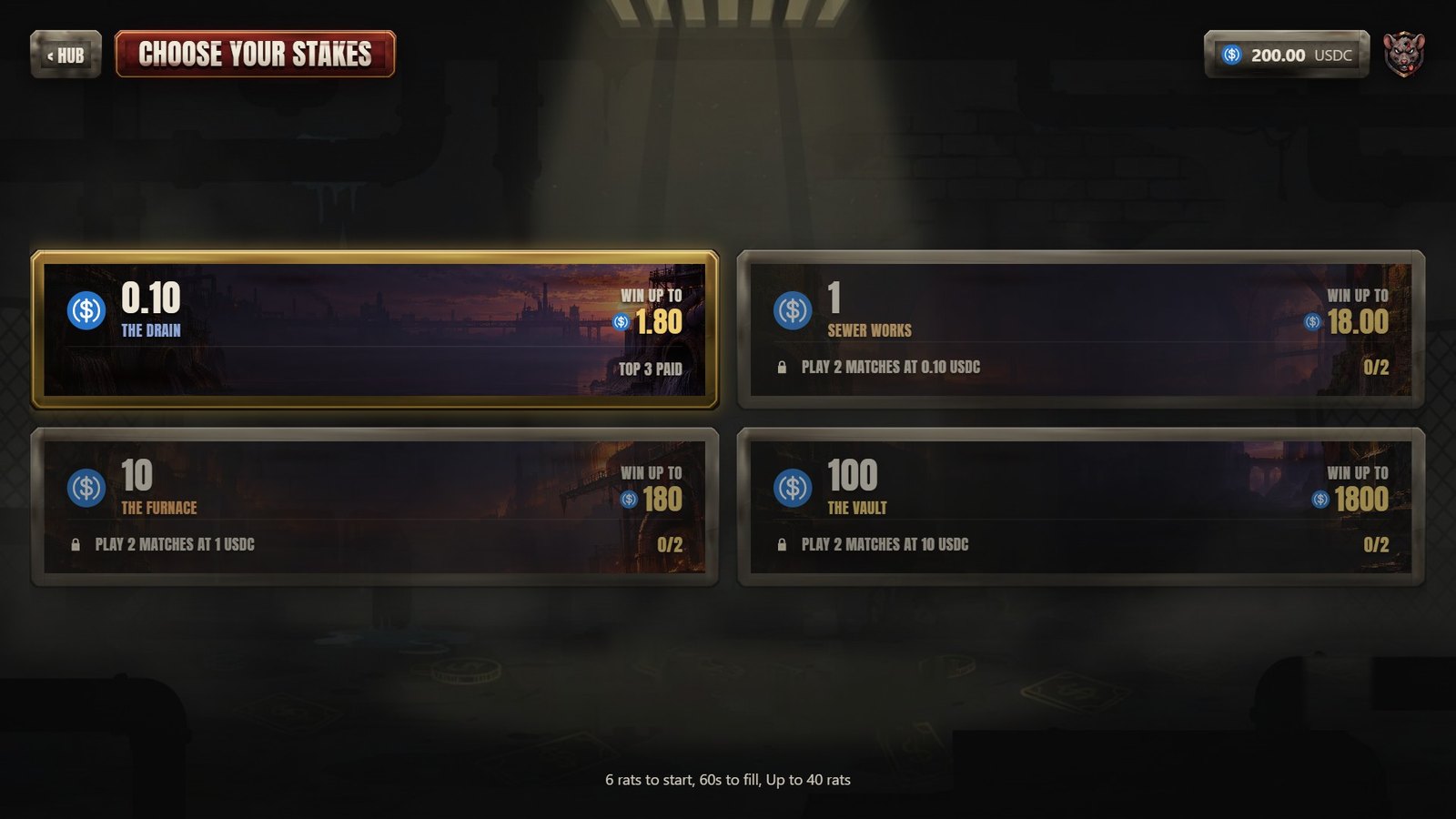
A pool needs at least 6 staked players to start and holds up to 40. Here's the whitepaper's own example for a full 1 USDC room. The pot is 40 USDC, the platform takes 4, first place gets 18, second gets 10.80 and third gets 7.20, and those amounts include the winner's original stake.
A full 1 USDC room: 40 USDC in the pot
- 1st place18.00
- 2nd place10.80
- 3rd place7.20
- Platform4.00
Now hold that against everything that went wrong with Axie and STEPN, because the design reads like a list of lessons learned.
There's no token. The whitepaper says it plainly: "RatPool has no token." That removes the whole minted-reward loop that sank the first generation of play-to-earn. Nobody is earning a currency that needs future buyers.
You don't need to buy anything to get in. In Axie you needed a team of NFTs before you could play, and in STEPN you needed a sneaker. In RatPool, the site says the pistol is free forever, and Free Play against bots is open at any time with no stake at all. You can learn the game, practise your aim and figure out the zone without spending anything.
You can't buy your way into a better payout. RatPool has seven weapons, and the store sells weapons with trade-offs. The whitepaper says the store doesn't sell health, armour or a bigger share of the pool, and purchases don't change the payout formula. So spending money can change your playstyle, but it can't make you win.
The money is locked in before the match. Stakes go into an on-chain escrow on Solana, and when the match ends the escrow pays the podium automatically. If a match isn't settled within 30 minutes of the stakes being collected, every stake goes back to the players in full with no fee taken, per the whitepaper. The money in the pot is there before anyone fires a shot, which is exactly the right-way-up order that play-to-earn lost.
Where a RatPool stake goes
- Players stakeEach entry goes into an on-chain escrow on Solana
- The room locksAt least 6 staked players when the lobby minute ends
- The match is playedThe room server reports the finishing order
Settled
The escrow pays the top three automatically: 50%, 30% and 20% of 90% of the pot.
Not settled in 30 minutes
Every stake goes back to its player in full, with no fee taken.
Getting started doesn't feel like crypto. You sign in with Google, an embedded Solana wallet is created for you, there's no seed phrase to write down and no SOL needed, and the platform pays all the network fees. That matters more than it sounds, because one of the reasons play-to-earn's audience stayed so narrow was how much crypto setup stood between a normal gamer and the first match. You can play in the browser at ratpool.xyz/play or download the Android app from the site.
The honest part: who actually earns in skill-to-earn
This is the part I promised to come back to, and it's the most important part of the whole comparison.
Skill-to-earn isn't a way for everyone to earn. It's a way for the best players to earn. In a full RatPool room of 40 players, three people get paid and 37 don't. Those 37 lose their stake for that match, and that's what funds the three payouts. The platform's 10% also comes out of the pool, so across all players combined, more money goes in than comes back out.
That might sound worse than play-to-earn, where almost everyone was earning something every day. But think about what that "everyone earns" actually meant. It meant everyone was earning a minted token whose value was being propped up by newcomers, until it wasn't. The 2021 scholars weren't really earning from the game. They were earning from the growth, and when the growth ended, almost everyone lost together, including people who had worked hard for months.
Skill-to-earn is upfront about the trade. You know before you join that only the podium gets paid, you know exactly what the split is, and you know the money is real. If you're improving, you'll start reaching the podium more often. If you're not, you can stay in Free Play for as long as you want without losing a thing. Being honest about who earns is less exciting than "everyone gets paid," but it's the only version that doesn't end with the last people in the door holding the losses.
Is skill-to-earn just gambling?
This question comes up every time, and it deserves a straight answer.
Gambling is betting on chance. In a slot machine or a roulette wheel, your decisions don't change the outcome. Skill-to-earn is closer to a tournament entry fee, because the outcome is decided by how well you play, your aim, your movement, how you handle the zone and how you survive. In RatPool's case, you aren't betting on another player or on a random result. You're only betting on yourself.
That said, the honest answer also has to include the law. Staking money on the outcome of a game, even a skill-based one, is treated differently in different countries, and some places restrict it. RatPool's whitepaper says access to paid pools depends on jurisdiction and applicable law, and that's the right way to put it. If you're thinking of playing for real money once any skill-to-earn game goes live, check the rules where you are.
What skill-to-earn still has to prove
It would be unfair to spend half this article on Axie's and STEPN's problems and then pretend skill-to-earn has none, so here's the other side.
Skill-to-earn depends on fair play. If the game can be cheated with aimbots or speed hacks, the best cheater wins instead of the best player, and the whole model breaks. RatPool's approach is to have the room server check every hit against the shot that caused it and flag only physically impossible actions, like moving or firing faster than the game allows, so it doesn't punish players just for being very good. That's a sensible design, and it will still need to hold up against real cheaters with real money on the line.
There's also trust in who reports the result. In RatPool, the escrow handles the money, but it can't see the match itself. The room server reports the finishing order, and the whitepaper openly says "the escrow trusts them." That's normal for real-time games, because a blockchain can't run a live shooter, but it means the integrity of that server matters a lot. The whitepaper also notes the upgrade key is currently a single key held offline, with a multisig planned before or at mainnet.
And it's early. RatPool is currently live on Solana devnet with test USDC, which the whitepaper says has no cash value. Mainnet with real USDC comes after an independent audit of the escrow and payments system. So right now it's a public test, which is actually a good moment to try it, because you can learn the game and the pools with test money before anything real is at stake.
None of this undermines the model. It just means a skill-to-earn game has to earn trust through fairness and security, where a play-to-earn game tried to earn it through token price.
So which one is better?
If the question is which model can pay players without eventually collapsing, skill-to-earn is better, and it isn't close. Play-to-earn's rewards depended on new money coming in, which is why Axie Infinity's daily users fell by more than half in five months and STEPN's GST lost 98% of its value in about two. Skill-to-earn pays from stakes that already exist in the pool, so it doesn't need growth to keep its promises.
If the question is which model lets everyone earn, the honest answer is neither. Play-to-earn only looked like everyone was earning, and it ended with the late players covering the losses. Skill-to-earn says upfront that the best players earn, and it gives everyone else a free way to practise until they're good enough.
Here's a prediction you can hold me to. By the end of 2027, nearly every crypto game still paying players will be paying them from entry fees, prize pools or outside revenue, and almost none will be paying them in a token the game mints for playing. The first wave already ran that experiment for us.
Earning from games was always a good idea. It just needed to be built the right way up, with the money in the pot first and the best player taking it. That's what skill-to-earn is, and that's what RatPool is building on Solana. If you want to see it for yourself, Free Play is open at ratpool.xyz/play, the staked pools run on test USDC during the devnet phase, and @Ratpoolxyz on X is where the updates land.
Quick facts
- Play-to-earn: games that reward players with tokens the game mints, where the value of those tokens depends mostly on new players buying in. Examples: Axie Infinity (SLP), STEPN (GST).
- Skill-to-earn: games where players put up entry stakes into a shared pool and the best performers win it under fixed rules, with no minted reward token.
- The core difference: play-to-earn needs growth to keep paying; skill-to-earn only needs people to keep playing.
- Axie Infinity: about 2.5M daily users in November 2021, about 1.2M by April 2022; SLP fell 99% from its February 2022 peak.
- STEPN: GST peaked at $9.36 in April 2022 and fell about 98% in roughly two months.
- RatPool: a skill-to-earn 2D arena shooter on Solana. No token, Google sign-in, sponsored fees, top 3 split 90% of the pool (50/30/20), 10% platform fee, up to 40 players, current devnet pools from 0.10 to 100 USDC (may change on mainnet).
- Status (November 2026): RatPool is live on Solana devnet with test USDC; mainnet follows an independent audit.