 RATPOOL
Where Does the Money in Play-to-Earn Actually Come From?
Every game that pays players draws on one of three sources. Follow a dollar through play-to-earn, then through a skill-to-earn pool, with the maths of a live example.
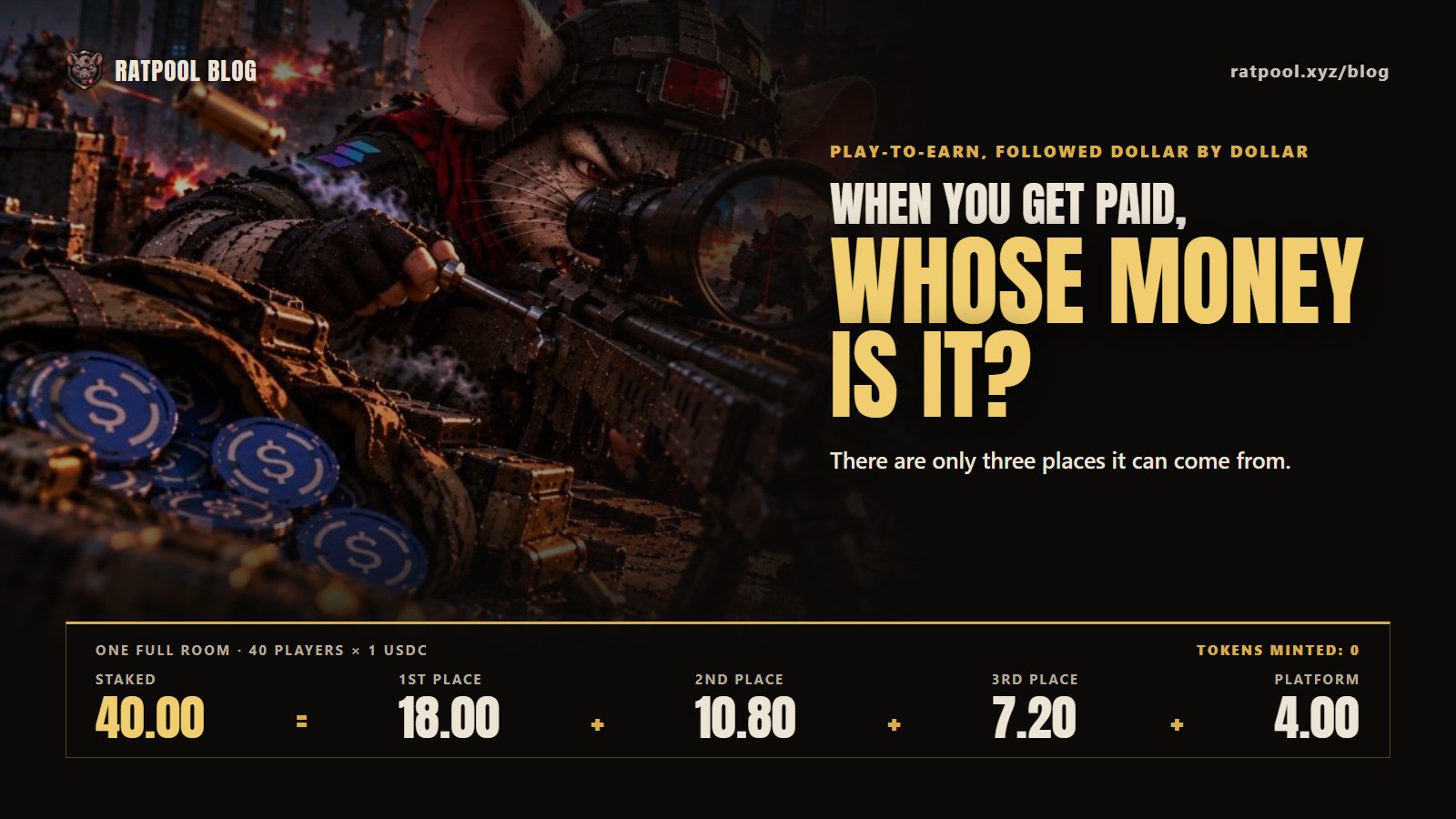
Every crypto game that promises to pay you has to answer one quiet question before anything else, and the answer decides whether it lasts one season or ten: when you get paid, whose money is it? In play-to-earn games like Axie Infinity and STEPN, the money mostly came from new players buying into the game, which is why payouts collapsed once growth slowed. In skill-to-earn games, the money comes from entry stakes that players in the same match have already put into a prize pool, so every payout is backed by funds that exist before the game starts.
That question sounds simple, and most people skip it because the screen in front of them shows tokens arriving in their wallet. But a token arriving in your wallet isn't money until someone gives you something for it. So the useful way to judge any earning game, old or new, is to forget the gameplay for a moment and trace a single dollar from where it enters the game to where it leaves.
That's what this piece does. It goes through the only three places the money in an earning game can come from, shows where play-to-earn sat on that map, and then runs the numbers on how a skill-to-earn pool actually moves money, using a live example.
There are only three places the money can come from
Every game that pays players gets the money from one of these three places, or some mix of them:
- New players. People joining the game spend money to get in, and that money flows to the people already there.
- Outside revenue. Someone outside the player base pays, such as advertisers, sponsors, a publisher's marketing budget, or fans buying cosmetics.
- The players in the match. Players put up stakes for a specific competition, and the result decides who takes them.
There isn't a fourth option. A game can't create money by minting a token. All minting does is create something that might be worth money, if one of those three sources is willing to pay for it. So when a game says it pays you, the real question is which of these three sources is standing behind the payout, and how long that source can keep paying.
The only three places the money can come from
New players
Newcomers pay to get in, and that money reaches the players already there.
Needs growthIt pays only while more people keep joining
Outside revenue
Fans, sponsors and advertisers pay from outside the player base.
Has a ceilingIt moves with outside interest and mostly reaches the top
The players in the match
Players stake into a pot, and the result decides who takes it.
Paid firstThe money is in the pot before the match starts
Source 1: New players, and why play-to-earn lived here
The first generation of play-to-earn sat almost entirely on the first source, even though it rarely described itself that way.
In Axie Infinity, you earned Smooth Love Potion (SLP) for playing. SLP was minted by the game, so it only became money when you sold it, and the main buyers were people breeding new Axies to sell to new players who needed a team. STEPN worked the same way with its Green Satoshi Token (GST) and NFT sneakers. In both cases, if you followed the dollar a player received when they sold their reward token, it led back to someone who had just joined.
Following a dollar in play-to-earn
- You play and earn a reward tokenSLP or GST, minted by the game, worth money only once sold
- You sell itThe buyer is mostly a breeder who needs it to make new NFTs
- The breeder sells those NFTsTo new players who need a team or a sneaker to start
- So your dollar came from someone who just joinedWhen joining slows, nobody buys the token
↺ Every payout waits on the next player
That's a perfectly fine source of money as long as more people keep joining. The problem is that it can only grow if the player base grows, and no player base grows forever. When growth slowed, the source dried up in front of everyone:
- Axie's daily active users went from about 2.5 million in November 2021 to about 1.2 million in April 2022, according to The Block.
- SLP fell 99% from its February 2022 peak, per Thomson Reuters Foundation's Context.
- STEPN's GST hit $9.36 in April 2022 and lost about 98% of its value in roughly two months, per CryptoSlate.
There's a full breakdown of how each of these games unravelled in What Axie Infinity and STEPN Taught Us About Play-to-Earn, so I won't repeat it all here. The point for this article is simpler. When the money comes from new players, the game's ability to pay you is tied to its growth rate, and it isn't tied to how good you are or how much you play.
Source 2: Outside revenue, which works but has a ceiling
The second source is the one traditional gaming has relied on for years, and it's healthier than the first, because the money doesn't come from players paying other players to join.
The clearest example is esports prize pools. Dota 2's The International 10 in 2021 had a prize pool of $40,018,195, built mostly from fans buying the Battle Pass, a bundle of cosmetics and features, with 25% of those sales going into the pool on top of a $1.6 million base, according to GosuGamers. Fans paid for things they wanted, and part of that money rewarded the best players in the world.
But outside revenue has a ceiling, and it moves with the outside world's interest. The International's pool the following year came in far lower, at about $18.9 million, less than half, according to Wikipedia's record of The International 2022, even though it was funded the same way. Sponsors also leave when budgets tighten, and advertisers pay for attention, not for skill.
The International's prize pool, funded by fans
There's also a scale problem. Outside revenue tends to reward a tiny group at the very top, like professional teams or tournament winners. It's very good at paying the best 0.01% of players and not very good at paying a decent player who just won a match on a Tuesday night.
So outside revenue is real money, but it depends on someone outside the game choosing to spend, and it usually only reaches the elite.
Source 3: The players in the match
The third source is the oldest one in competitive gaming. Players who want to compete for money put up a stake, the stakes form a pot, and the result of the match decides who takes it. That's how a game of pool for money in a bar works, how poker cash games work, and how chess clubs have run small prize tournaments funded by entry fees for generations.
This is the source skill-to-earn uses, and it has three properties the other two don't:
- The money exists before the game starts. The pot is collected first, so there's no question of whether a buyer will turn up later.
- It doesn't depend on growth. A pool of 40 players pays exactly the same whether the game gained a thousand new users that week or none.
- It reaches ordinary winners. You don't need to be a professional to take a pot. You just need to beat the people in your match.
The trade-off is that it's a closed loop. The players in the match fund the payouts to the players in the match, so for one player to win, others have to lose, and the platform running it takes a fee. That's the honest cost of a source that never runs dry, and it's worth looking at in real numbers.
Following a dollar through a skill-to-earn pool
Theory only goes so far, so here's exactly how the money moves in a live skill-to-earn game.
RatPool (@Ratpoolxyz) is a real-time multiplayer 2D arena shooter on Solana where players score from kills and from holding a moving zone. Players who want to compete for money join staked pools, and the RatPool whitepaper lays out the money flow in four steps:
- Approve. Joining a pool approves exactly one entry. No funds move while you wait in the lobby.
- Collect. When the room locks with at least 6 and up to 40 staked players, the stakes are collected into a match vault held by an on-chain escrow program.
- Settle. When the match ends, the escrow pays the top three their share, sends the platform its fee and pays any invite rewards.
- Refund if needed. If the match isn't settled within 30 minutes of collection, settlement is refused and every stake goes back in full, with no fee deducted.
The split is fixed. The top three by score share 90% of the pool at 50%, 30% and 20%, and the platform keeps 10%. If a podium finisher joined through someone's invite link, 1% of the pool goes to the inviter, shared equally if more than one podium finisher was invited, and that comes out of the platform's share, so the players' 90% never changes.
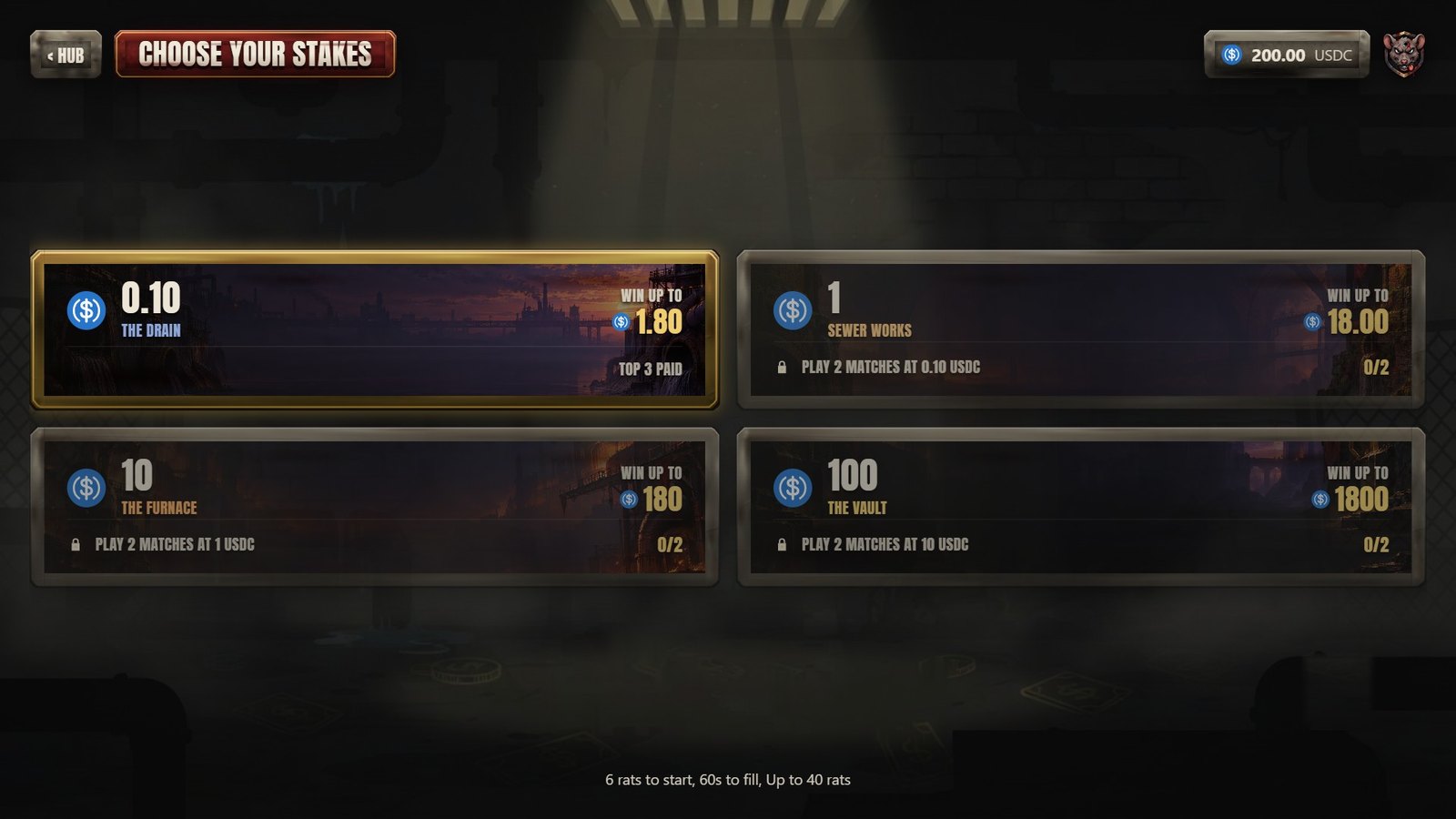
Now the numbers. Take the whitepaper's own example of a full 40-player room with a 1 USDC entry, which is one of the current devnet tiers (entry prices could change on mainnet, but the split works the same at any price):
- Total pot: 40 USDC
- First place: 18 USDC, which is 17 USDC profit after their own stake
- Second place: 10.80 USDC, or 9.80 profit
- Third place: 7.20 USDC, or 6.20 profit
- Platform: 4 USDC (or 3.60 plus 0.40 to inviters if an invite reward applies)
- Everyone else: 37 players each lose their 1 USDC stake for that match
Add it up and it balances exactly. The 37 USDC lost by the other players covers the 33 USDC of combined profit for the podium plus the 4 USDC platform fee. Nothing is minted, and nothing is waiting on a future buyer. Every cent paid out was sitting in the vault before the first shot was fired.
A full 1 USDC room, followed to the cent
In the vault before the first shot
40 players × 1 USDC40.00
Paid out when the match ends
1st place 17.00 profit18.00
2nd place 9.80 profit10.80
3rd place 6.20 profit7.20
Platform, 10%4.00
Paid out in all40.00
Tokens minted0.00
A smaller room works the same way. With the minimum of 6 players at 1 USDC, the pot is 6 USDC, first place takes 2.70, second 1.62, third 1.08, and the platform keeps 0.60.
The part most earning games never show you: expected value
This is where follow-the-money analysis gets uncomfortable, and it's the part that separates an honest earning game from a dishonest one.
In a skill-to-earn pool, the average player loses money over time. That's just arithmetic. If the platform takes 10% of every pool, then across all players combined, every 1 USDC staked returns 0.90 USDC on average. So a player of exactly average skill should expect to lose about 10% of what they stake over many matches.
That sounds bad until you compare it with the alternative. In play-to-earn, an average player's expected value wasn't a fixed number at all. It depended almost entirely on when they joined. Early players had hugely positive returns, and late players had hugely negative ones, often losing most of what they paid for their NFTs. And nobody showed those players the maths before they joined.
What a player can expect, and when they find out
Play-to-earn
- Early players: large gains
- Late players: often most of what they paid for their NFTs, lost
- Decided by when you joined
- Shown to you: never
Skill-to-earn
- Average players: about the 10% fee, over time
- Above-average players: can come out ahead
- Decided by how you play
- Shown to you: before you stake
In skill-to-earn, the maths is fixed and visible before you stake anything:
- Average players lose roughly the platform fee over time, the same way the average poker player loses the rake.
- Above-average players can come out ahead, because they finish on the podium more often than chance alone would allow.
- Players who are still learning don't have to stake at all. RatPool's Free Play is open against bots at any time, and the pistol is free forever, so you can get good before you put money in.
That's what an honest earning game looks like. It tells you up front that the edge comes from skill, it shows you the fee, and it gives you a free way to find out whether you have the skill before you pay for it.
Why the platform's incentives matter too
There's one more dollar worth following, and that's the one the platform keeps.
In play-to-earn, game studios often held large amounts of their own token, and their treasury value rose and fell with the token price. That gave them a reason to focus on keeping the token up, which sometimes meant pushing growth at almost any cost.
In a fee-based skill-to-earn model, the platform earns a percentage of each pool that actually runs. Its revenue depends on how many matches get played, and it has nothing to gain from a token price, because there's no token. RatPool's whitepaper puts it in one line: "RatPool has no token." So the only way for the platform to grow its revenue is for more people to keep playing more matches, which means the game has to stay fun and fair. That puts the platform's interest and the players' interest in the same place.
It also means the platform has no reason to favour whales. The whitepaper says the store sells weapons with trade-offs but doesn't sell health, armour or a bigger share of the pool, and purchases don't change the payout formula. A player who spends a lot and a player who spends nothing face the same split.
What you still have to trust
Following the money in a skill-to-earn game also shows you where the trust sits, and it's worth being specific about it.
The money itself sits in an on-chain escrow with fixed rules, so the split and the 30-minute refund deadline are enforced by the program and not by anyone's promise.
The result is a different matter. A blockchain can't run a live shooter, so the room server runs the match, controls health, scores, the clock and the zone, and reports the finishing order to the escrow. The whitepaper is open about this, saying the escrow "trusts them." That means the integrity of the room server is the main trust assumption in the whole system.
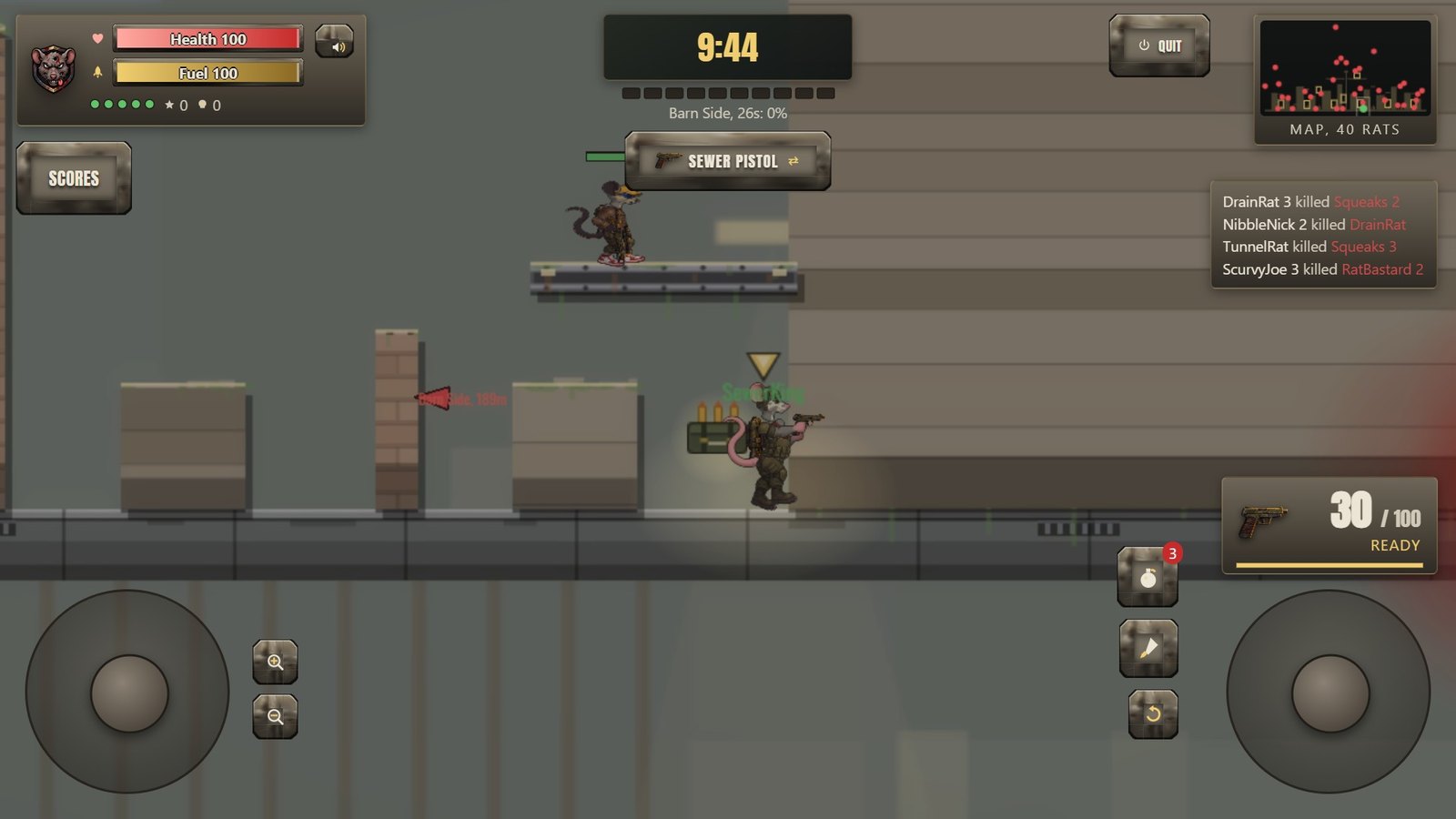
Fair play depends on that same server. RatPool's approach is to check every hit against the shot that caused it and to flag only physically impossible actions, like moving or firing faster than the game allows, so it doesn't punish players for being very good.
Upgrades are worth knowing about too. The whitepaper says the escrow's upgrade key is currently a single key held offline, with a multisig planned before or at mainnet.
Timing matters as well. RatPool is live on Solana devnet with test USDC, which has no cash value, and mainnet with real USDC comes after an independent audit of the escrow and payments system. Access to paid pools will depend on the laws where each player lives, as the whitepaper notes.
None of this is hidden, and that's the point. When you can trace the money, you can also see exactly what you're trusting, which is more than play-to-earn ever offered.
The one-sentence test
Here's the flag I'll plant: if a game can't tell you in one sentence where your winnings come from, assume they come from the next person to join.
Play-to-earn usually couldn't pass that test, because the honest sentence ("your winnings come from new players buying in") would have scared people away. Outside-revenue games can pass it, but the money they describe mostly reaches the top professionals. Skill-to-earn passes it with a sentence anyone can check: your winnings come from the stakes of the players you beat in that match, minus a fixed fee.
And here's a claim you can verify for yourself. In a pool-based skill-to-earn game running on-chain, total payouts in any period can never be more than the stakes collected in that period, and once RatPool is on mainnet, anyone can confirm that by reading the escrow's transactions on Solana. If a game's payouts ever exceed what players put in, the extra money has to be coming from somewhere else, and that's exactly the question this whole piece is about.
If you want to follow a dollar through a pool yourself, RatPool runs its staked pools on test USDC during the devnet phase, Free Play is open at ratpool.xyz/play, and updates go out on @Ratpoolxyz. For the full head-to-head comparison of the two models, read Play-to-Earn vs Skill-to-Earn: Which Is Better?
Quick facts
- The three sources of money in any earning game: new players, outside revenue, and the players in the match.
- Play-to-earn relied mainly on new players, through reward tokens like Axie's SLP and STEPN's GST whose value depended on newcomers buying in.
- Outside revenue is real but limited. Dota 2's The International 10 pool reached $40,018,195 in 2021, funded largely by 25% of Battle Pass sales, and the next year's pool, funded the same way, came to about $18.9 million.
- Skill-to-earn pays from stakes the players in a match put up, so payouts exist before the match starts and don't depend on growth.
- Expected value: with a 10% platform fee, an average-skill player loses about 10% of what they stake over time, and above-average players can come out ahead.
- RatPool: a skill-to-earn 2D arena shooter on Solana. No token, on-chain escrow (approve, collect, settle, or full refund after 30 minutes), top 3 split 90% (50/30/20), 10% platform fee, 1% invite reward paid from the platform's share, 6 to 40 players per pool, current devnet tiers from 0.10 to 100 USDC (may change on mainnet).
- Status (November 2026): RatPool is live on Solana devnet with test USDC; mainnet follows an independent audit.